
Newsletter - Spring 2026
From Executive Director Dr. Susan Ouellette: Looking Forward to the 2026 Season
Executive Director Dr. Susan Ouellette
Recently I gave a patron a quick tour and he marveled at the changes we have accomplished: our beautiful museum building is more comfortable, secure, and inviting than ever. Through his eyes I was reminded of just how far we’ve come. This year will be no different in our move forward into the future. By the end of May, our contractor – FPI Mechanical – will have completed the installation of our cutting-edge, efficient HVAC system. The heat pumps will profoundly change the summertime experiences of visitors as well as better protect the integrity of our restored plasterwork and important artifacts. We are now focused on the next chapter: the restoration of the former cherry wainscotting. This component of the restoration will be expensive and will require fundraising to accomplish, but it will be an amazing step towards returning the building to its former glory. HBO come look at us now as a filming location for the next season of “Gilded Age”!
Finally, along with the interior enhancements to our Gilded Age gem, we are also planning to enhance existing exhibits and develop new ones. Stay tuned to find out about our amazing changes, both inside and out. Our 2026 season will be the best one yet!
In addition to the work on our museum building, our grounds have undergone a major transformation as well. Gone are the tangled vines and unruly trees! Our groomed outdoor spaces will provide a pleasant place to sit or have a nice picnic lunch. We hope to have benches and maybe a picnic table or two for casual visitors. And our exciting exterior project – a proposed mural on the long concrete wall adjacent to our parking area – will provide a beautiful focal point for visitors. Developed and executed by local artist Kevin Clark, the mural will include images drawn from Troy’s industrial heritage. Supported in part by the City of Troy, private donations, and grants, our mural will be a stunning addition to the public art that enlivens our community.
Museum disrupted
Installation of new HVAC system moving ahead
Overall, we here at the Burden Ironworks Museum hope you will take the time to visit and experience our new looks and improved amenities. Happy Spring!
We hope you enjoy our Spring Newsletter. It features articles on the sad tale of an inventor who tried to market a horseshoe machine in competition with Henry Burden and the bicentennial of bell casting in the Hudson Mohawk region, and a brief biography of a Scottish immigrant who worked at the Burden iron works for nearly 60 years before passing away 100 years ago.
Not Every Inventor a Success
Thomas Edison had more than 2,000 patents. Henry Burden had only twelve, but almost every one of them was a commercial success for him: the hook-headed railroad spike machine, the rotary concentric squeezer, and of course the three horseshoe making machines. But not every inventor finds success.
Rowe patent model
The Burden Iron Works Museum has a small exhibit on Bradford Rowe. He was born in Vermont and moved to Albany around 1850, where he opened a cobbler’s shop. In addition to working as a shoemaker and bootmaker, Rowe patented three machines for processing leather (the patent model for one machine is on display). However, it appears that none of the inventions was a commercial success, and when he died in 1867, he left his wife impoverished.
Another interesting story is that of Joseph H. Dorgan of Plattsburgh, New York. He patented a horseshoe making machine in 1880 but was in the end unable to turn it into a commercial success.
Dorgan patent application (CLICK to enlarge!)
It appears that Dorgan did not have an engineering background, but his description of his invention in the patent application and the drawings he included are detailed and technical. However, it is not clear from his description how his horseshoe machine actually made a horseshoe, and how it differed from a machine based on any of Burden’s patents.
In any case, three years later he was still having no luck getting anyone to invest in his invention. On July 20, 1883, the Plattsburgh Sentinel ran an item on Dorgan’s invention. Although it was carried as “A Letter from One of Our Citizens” and signed “Observer,” it may have perhaps been a desperate attempt by Dorgan himself to drum up local investor interest.
“Mr. Dorgan’s horseshoe machine is an undoubted success.” The letter starts. “This is the reward of years of patient and persevering toil, as the writer of this well knows, and it would only be meet and just that his own townsmen who have been blessed with affluence should come forward and take part in this enterprise.” The letter states that the invention has “but three competitors in the United States, Burden and Walker, near Troy, N.Y., and Perkins in Rhode Island.” The writer then asserts that Dorgan “has revolutionized the entire business by simplifying the machinery, so the cost of manufacture is greatly reduced.” As an inducement to investors, the letter claims that two machines running 10 hours per day would net the investor a profit of over $31,000 annually. The letter concludes, “[It] is to be hoped that Plattsburgh and its capitalists may have the full benefit of it, and Mr. Dorgan may live to see his new enterprise achieve as great a success as he could wish, while reaping an abundant harvest.”
Dorgan patent model
Unfortunately, even this advertisement was not successful, and Dorgan continued on as a merchant. City directories list him as owning a liquor store and grocery store at various times. (He may have been a tinkerer in his spare time.)
Dorgan was born in 1832 in County Cork, Ireland, and died in 1890 in Plattsburgh. His wife Alice lived until 1908, and they had four children. The family is buried in Mount Carmel Cemetery in Plattsburgh.
We thank Helen Nerska, director of the Clinton County Historical Association, for providing information for this article. The newspaper article cites Burden and two other horseshoe machine makers, Perkins and Walker. See the Gateway Facebook post of March 16, 2026, for information on Perkins. We were unable to find any relevant information on a Walker in Troy. Patent model photo courtesy of Hagley Museum & Library.
200th Anniversary of Meneely Bells in Watervliet
Andrew Meneely
Andrew Meneely started his bell foundry in Gibbonsville, New York (later West Troy and now Watervliet), in 1826. The foundry grew to be one of the largest in North America. It is believed that the Meneely foundry in Watervliet, along with the bell foundries in Troy, cast as many as 65,000 bells which today can still be discovered all around the globe.
The Meneely story begins with Julius Hanks, a bell caster who had worked with renowned silversmith Paul Revere. Hanks moved from Litchfield, Connecticut in 1808 to open a bell foundry in Gibbonsville. Andrew Meneely, who was born in Gibbonsville, began an apprenticeship with Hanks at age 15 in 1817. After spending some time with Hanks in Auburn, New York, casting items for the construction of the Erie Canal, Meneely returned to Gibbonsville and took over the former Hanks bell foundry in 1826.
Meneely ad showing West Troy foundry
Meneely was famous not only for the quantity of bells he cast, but also for their quality. He constantly strove to improve the tone and quality of his bells by experimenting with the thickness and shape of the bell and temperature of the metals used in the casting (copper: 78% and tin: 22%). Meneely guaranteed the tone of their bells, and learned how to “tune” them if the sound was off. Meneely also patented a bell yoke that allowed the bell to be rotated to avoid flat spots, which could change the tone of the bell.
Philena Hanks Meneely
This led him to develop sets of multiple bells (peals: seven bells; chimes: 8-15 bells; carillon: 16 or more bells) which in turn allowed the bells to play simple tunes. They sold 195 chimes – more than any other bell foundry in America. Four of these went to Troy churches: Holy Cross Episcopal, Woodside Presbyterian, Ascencion Episcopal, and St. John’s Episcopal. Their largest carillon was the 49-bell Plumb Memorial Carillon at Trinity College in Connecticut.
The company also briefly made tower clocks that could sound the hour on Meneely bells.
Andrew Meneely died in 1851. His two oldest sons, Edwin and George, took over the company. They ceased making tower clocks to concentrate on bells. The company under their leadership was not successful and it failed in 1857. Andrew’s widow Philena Hanks Meneely (Julius Hanks’ niece) then took over the management, and the company returned to solvency in 1863.
The business closed in 1951. The foundry complex stood on Broadway in Watervliet until the 1970s. One of the Gateway’s earliest activities was to advocate for the adaptive reuse of the site, but it was demolished. Today, there is only a historic marker there.
Meneely bell tower at Albany Rural Cemetery
CLICK ON IMAGE TO ENLARGE
Meneely family grave site at Albany Rural Cemetery
Andrew Meneely, his wife, and several family members are buried at Albany Rural Cemetery in Menands. The cemetery also had a Meneely bell mounted on a tower, but the tower was removed for safety reasons, and the bell is in storage.
The Watervliet Historical Society and the Friends of Albany Rural Cemetery are planning events later this year to celebrate the Meneely bicentennial. Watch our Facebook page for updated information.
This article is based on information from the Winter 2026 Newsletter of the Friends of Albany Rural Cemetery and the book The Bell Casters of Troy by Sydney Ross, both used with permission.
Scottish Immigrant Andrew Kidd Worked at Burden for Nearly 60 Years
Andrew Kidd
The Burden Iron Co. and its predecessor companies undoubtedly had many long-term employees over their nearly 100 years of existence, but probably none of them matched the longevity of Andrew Kidd, who worked at Burden for 59 years. He died one hundred years ago, shortly after retiring.
According to information provided by his descendants, Andrew Kidd was born in 1843 at Lochwinnoch in Renfrewshire, Scotland. He received an engineering degree there before emigrating to the United States in 1868 with his wife Martha Ralston. Upon his arrival, he immediately began working for the Henry Burden & Sons, the predecessor of the Burden Iron Co., which means he might have known Henry Burden, who died in 1871.
Kidd in full Scottish regalia
Family accounts portray Kidd as particularly proud of his Scottish ancestry. He apparently excelled at many sports, including several peculiar to his homeland, which he enjoyed as a member of Troy’s Caledonian Society. Like many Burden employees from Scotland, the Kidds became active members of Woodside Presbyterian Church, the church along the Wynants Kill in Troy that Henry Burden erected as a memorial to his wife Helen.
Unfortunately, we do not know a great deal about Andrew Kidd’s work at the Burden Iron Co. For example, we do not know what his first job was, although with an engineering degree he probably started in a supervisory position. According to the family, however, in less than fifteen years he had risen to chief engineer, and he continued in that position until his retirement at age 83 in April 1926, shortly before his death. We should note, however, that existing Burden payroll records do not include the position of chief engineer, but Kidd is listed as foreman.
Andrew and Martha Kidd had three sons and five daughters. In addition, Martha’s mother and at least two of his sisters relocated to Troy from Scotland. By the time of his death in 1926, Andrew and Martha had 21 grandchildren and 8 great-grandchildren. The family lived at 560 First Street, about a block from the iron works, possibly in a house rented from the company. Many members of the family are buried in the Kidd family plot at Troy’s Oakwood Cemetery.
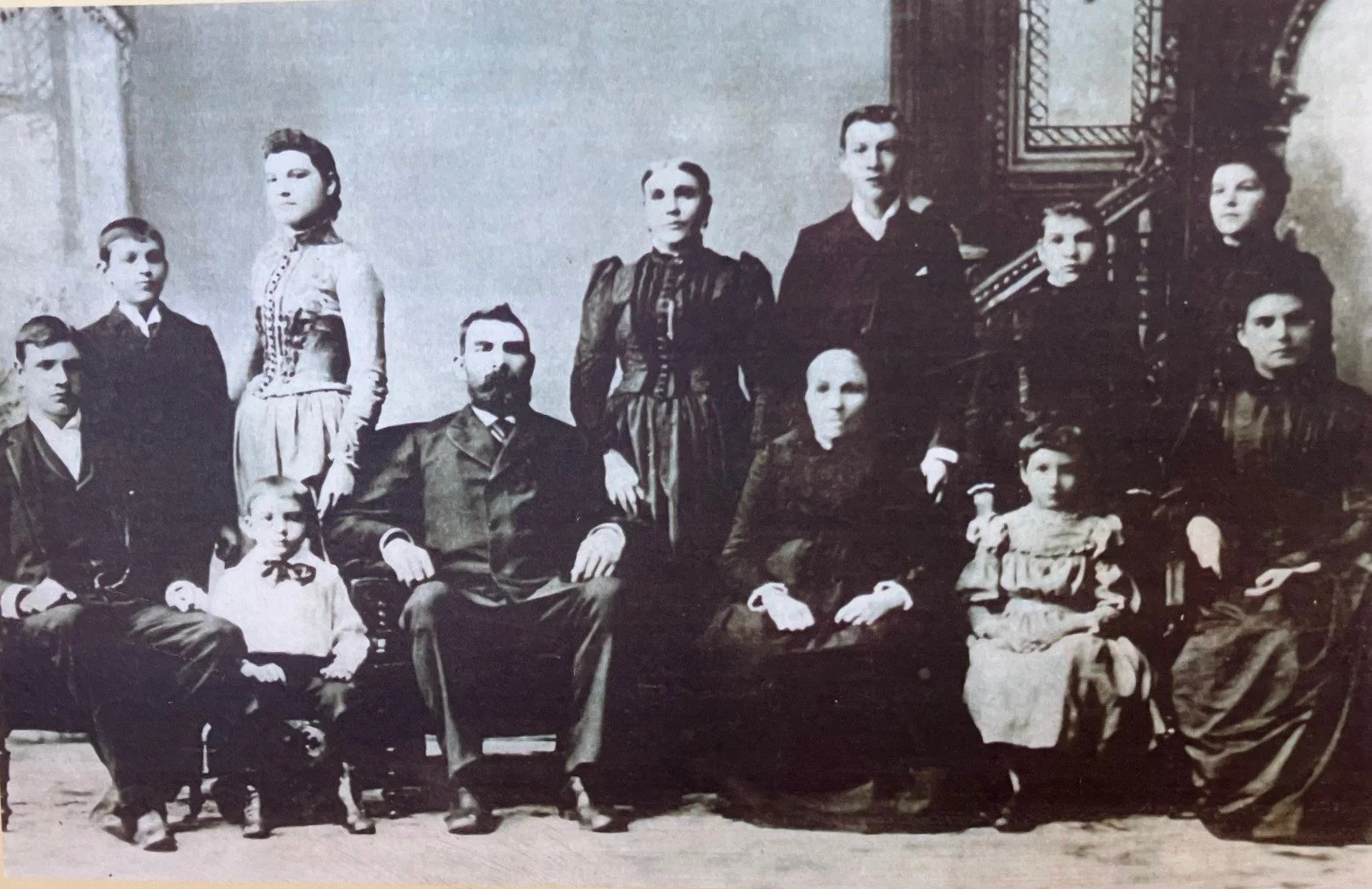
Extended Kidd family circa 1888