Newsletter - Fall 2026
From the Executive Director
Susan Ouellette, Executive Director
As our reputation grows, we are welcoming more and more visitors. And for the first time, they are able to tour the museum in the summer in air-conditioned comfort, thanks to the new heat-pump heating, ventilating and air conditioning (HVAC) system installed over the winter. No more days when we have to close because the museum is too hot! We thank Peter and Susan Grimm again for their support of this project.
We continue to be a popular excursion for passengers on the American Cruise Line ships that call in Troy. We expect to host passengers from 10 ships in October during the “Fall Foliage” tour season.
And if you can’t visit us in person, Matt and Nicole from local PBS television station WMHT recently came to the Burden Iron Works Museum and produced a short video episode for their series "Field Trip." Watch it here (scroll down): www.wmht.org/fieldtrip/
We conducted another successful “Troy Tiffany Treasures” tour September 12. The sold-out event organized by Gateway Trustee Suzanne Spellen attracted visitors from as far away as Long Island. Because of the demand for this tour, we are considering offering a Spring tour as well.
Tour group at St. Joseph's Church in South Troy
Stained glass window
Finally, we have recently learned that the Albany Institute of History and Art has plaster busts of Henry and Helen Burden made by renowned Albany sculptor Erastus Dow Palmer. We are in early discussions with the Institute about loaning the busts to us.
2026 Gala Honors Sage Brothers
Gala invitation
The Gateway was pleased to honor Sage Brothers Painting Co., Inc. at our annual Gala October 1 in Troy. The company is a third-generation, family-owned commercial and industrial painting contractor that has been active in the Troy region since its founding in 1945 by John J. Sage. The company is currently led by John’s son Bill and grandson Kevin. They have completed several interior and exterior painting projects at the Burden Iron Works Museum. In 1969 the company linked its legacy to Troy’s industrial heritage by purchasing the historic 1873 Troy Gas Light Company Gasholder House. After Bill and Kevin Sage received their award, Bill Sage remarked that while they initially regarded the historic structure as just a warehouse for their specialized scaffolding and equipment, they soon became dedicated preservationists of the landmark. For over half a century, they have generously opened the Gasholder to the community for arts installations, civic benefits, and cultural events, blending their successful commercial contracting enterprise with a profound commitment to local historian stewardship.
Honorees Bill and Kevin Sage and their families
The Gala drew a good crowd
Gateway volunteer extraordinary Donna Done also received an award to acknowledge her many years of dedication to the Gateway. Among the Gala attendees were Henry Burden descendant Ada Gates and Duncan and Rowena Comrie from Scotland, where Duncan promotes Henry Burden’s legacy.
Executive Director Susan Ouellette presents awards to Gala Honorees Bill and Kevin Sage
Donna Done was recognized for her contributions as a volunteer
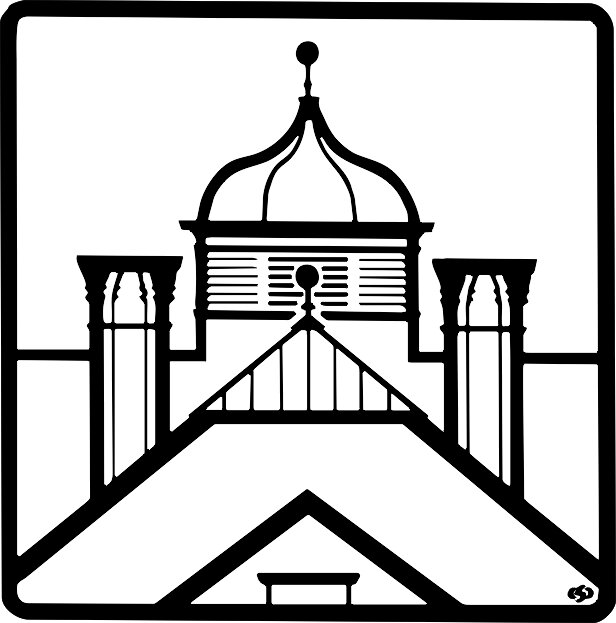
The Troy Gasholder House is one of the very few such structures still standing in the United States. The distinctive shape and construction of the structure led it to being chosen as the logo for the Society for Industrial Archeology. For the complete history of the Troy Gasholder House, see the article in the Fall 2021 Gateway Newsletter.
The Society for Industrial Archeology logo features the Troy Gasholder House
New Mural Completed
Panoramic view of Kevin Clark mural
A new mural celebrating Troy’s industrial history was inaugurated September 10 at an event attended by City of Troy officials and Gateway friends. The mural was painted by local artist Kevin Clark, who also painted the Burden Water Wheel mural at the foot of Mill Street in Troy as well as several others around the city. The twelve-foot-high mural stretches nearly 180 feet along the wall separating the museum property from our southern neighbor. Gateway volunteers power-washed the wall to prepare it for painting. Like the Sistine Chapel ceiling, this work is so large it cannot be appreciated at one glance. The mural includes images of Henry Burden, his water wheel, and his horseshoe machine; Garnet Douglass Baltimore, Rensselaer Polytechnic Institute’s first Black graduate and a prominent local engineer; the textile industry; Troy-made pianos; bell casting; Troy’s role in building the USS Monitor; a General Electric steam engine and dynamo rescued from the old Ludlow Valve site in Troy; and a steam yard engine used by Burden Iron Co. Funding from the mural came from the City of Troy through ARPA, the Capital Resource Corporation, Arts in the Capital Region, and private donors.
Mural artist Kevin Clark
City of Troy officials and Gateway friends at the September 10 event
From Troy and Albany to the Moon
A space capsule built in Albany or Troy may not have really reached the moon, but a precision instrument made in Troy certainly did.
Apollo 8 was the first spacecraft to orbit the moon in 1968, but such a voyage had been foreseen by French science fiction writer Jules Verne just over one hundred years earlier in his novel From the Earth to the Moon. The novel was published in French in 1865; the first American edition was published in 1873.
Depiction of the moon capsule as imagined by Verne
In Verne’s novel, he imagines that in the years after the Civil War eventually ends, an enormous cannon is constructed near Tampa, Florida, to propel a space capsule containing three human passengers (and some animals) to the moon. Following is Verne’s description of the cannon and the capsule:
“The projectile should be a shell made of aluminum with a diameter of 108 inches and a thickness of 12 inches on its wall; and should weigh 19,250 pounds. Second, that the gun should be a Columbiad cast in iron, 900 feet long, and run perpendicularly into the earth. Third, that the charge should contain 400,000 pounds of gun-cotton, which, giving out six billion litres of gas in rear of the projectile, would easily carry it toward the orb of the night.”
The cannon was constructed on site, using special cast iron supplied by the West Point Foundry in Cold Spring, New York, a real company with extensive experience casting artillery for the U.S. Army. But where was the capsule built? Here’s where things get a little confusing. In Verne’s original French text, he said that the aluminum capsule was cast by Breadwill and Co., a fictitious company, but one he located for some reason in Albany, New York. However, in the first American translation of the book, Breadwill and Co. becomes the Meneely Bell Foundry in Troy, New York.
Further research reveals that “The original 1873 English translation by Lewis Page Mercier and Eleanor E. King famously altered, Americanized, or outright localized parts of Verne's French text … to make the text relatable to 19th-century American readers…. [T]he translators explicitly credited the Meneely Bell Foundry (a real-world, famous industrial bell company operating out of Troy, New York) as the manufacturer of the bell-shaped spacecraft.”
Well, even if Meneely did not make the space capsule, it is interesting that the translators knew the company was widely renowned for skillful casting.
Geier & Bluhm bubble level
Man first reached the moon on the Apollo 11 mission in 1969. Later Apollo missions carried scientific instrument packages to the moon. Included in these instrument packages were bubble levels made by Geier & Bluhm of Troy used to make sure the instrument package was perfectly level and plumb. A bubble level consists of a capsule filled with liquid, with a bubble of air injected into it and then sealed. So, it is true, as docents at the Burden Iron Works Museum tell visitors, “There is Troy air on the moon.” Geier & Bluhm is still in business today, operating as part of HJM Precision, Inc.